Peer-reviewed Journal Articles
Working Papers
Book Manuscript
Taming the Careerists: The Politics of Foreign Policy Implementation
– Book overview(Link)
– Book workshop held on September 27, 2024, at Syracuse University
– Forthcoming at Cambridge University Press (Fall 2026)
Over two million bureaucrats serve in the U.S. federal government under various employment contracts. Taming the Careerists asks how the design of those contracts—specifically, the features that strengthen or weaken job protections—shapes behavior of bureaucrats and, in turn, American foreign policy. While past studies identify tools that help the president control the bureaucracy, Kim demonstrates that the president can additionally control behavior of bureaucrats by weakening job protections, which makes bureaucrats more accountable to presidential preferences. The book shows that bureaucrats adjust how they implement policy based on the structure of their job protections, and that weakening these protections can unintentionally disrupt the stability of foreign economic policy. Drawing on administrative data, policy memos, interviews, and computational text analysis, Kim reveals the trade-off between democratic accountability and stability, shedding light on the personnel management rules that quietly sustain the daily work of America’s foreign policy bureaucracy.
Peer-reviewed Journal Articles
International Bureaucrats under Transparency: The Case of the WTO TRIPS Council (co-authored with Sojun Park)
– 2026. Review of International Organizations. Online First. (Manuscript) (Appendix)
– DOI: https://doi.org/10.1007/s11558-025-09606-2 (Open Access)
How does transparency affect the behavior of international bureaucrats tasked with facilitating negotiations? Existing theories offer opposing expectations—greater transparency might induce international bureaucrats to engage more with contentious issues that matter to the public or lead them to avoid those issues whenever possible. We assess these competing perspectives by analyzing the World Trade Organization (WTO)’s 2002 document de-restriction reform that enhanced transparency to the public. Specifically, we examine how prompt public disclosure of documents shapes the way the WTO Secretariat writes reports about the Agreement on Trade-Related Aspects of Intellectual Property Rights (TRIPS). Using network statistics to estimate the state preference distributions on key topics, we find that, after the reform, the WTO Secretariat is more likely to issue reports on polarized topics in negotiations, using accountability-enhancing words. Our analysis at the country-year level shows that the reform led to greater national newspaper coverage of the WTO TRIPS, which in turn raised public awareness. The results suggest that transparency could empower international bureaucrats to tackle divisive issues in times of member-state gridlock.
Bringing Home the Bacon: Politician Ambassadors and Home State Trade (co-authored with Shu Fu)
– 2025. World Politics 77(2), 382-417. (Link)
– DOI: 10.1353/wp.2025.a957998
Ambassadors promote domestic exports to a host country and represent the interest of their home country at large. However, are trade benefits equally distributed domestically? In the United States, a substantial number of ambassadors are former governors or legislators (“politician ambassadors”). We argue that politician ambassadors are particularly equipped with knowledge and incentives to promote exports from their home states to host countries. Leveraging the biographic information of 164 ambassadors and US state-level exports to 30 major export destinations from 2002 to 2020, we find that the home states of politician ambassadors, compared to other states, on average enjoy a 10 percentage point increase in exports to host countries. The home-state effect is particularly apparent in countries where the US exports the most in dollar values, and in industries that export final goods. The past career path and future career aspirations of ambassadors can shape how the benefits of diplomacy are distributed domestically.

How Bureaucrats Represent Economic Interests: Partisan Control over Trade Adjustment Assistance
– 2024. International Studies Quarterly, 68(3). sqae089. (Link)
– DOI: 10.1093/isq/sqae089
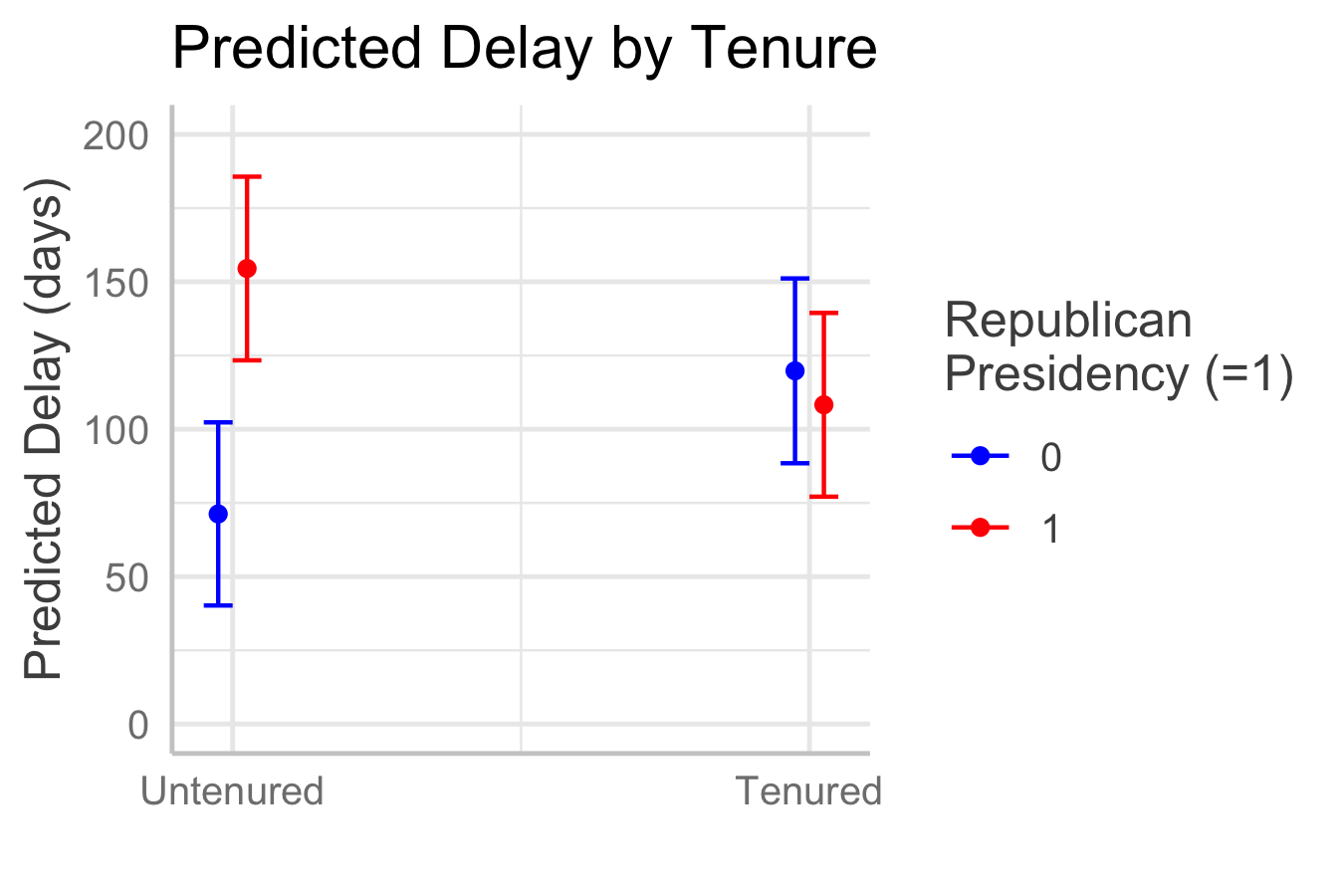
Embedded liberalism prescribes compensating workers hurt by globalization, but government compensation programs are often criticized for their lack of responsiveness. I explain the lack of responsiveness by illuminating bureaucrats who approve the compensation programs in the frontline. I examine how career bureaucrats distribute Trade Adjustment Assistance (TAA) benefits, the single largest federal program in the United States that compensates workers displaced by international trade. Exploiting the quasi-random assignment of TAA petitions to individual investigators at different stages of their careers, I find that career bureaucrats are less likely to certify TAA petitions and are more likely to delay investigations during Republican presidencies relative to Democratic presidencies. This partisan performance, however, applies uniquely to career bureaucrats who are not tenured and increases in magnitude during periods of high alignment between labor and the Democratic Party. The political sustainability of globalization depends on an institutional design that shapes the career incentives of bureaucrats.
Electoral Rewards and Punishments for Trade Compensation (co-authored with Robert Gulotty)
– 2024. World Politics 76(2), 259-293. (Link)
– DOI: 10.1353/wp.2024.a924507
When globalization harms a community, voters are expected to demand compensation programs. Why, then, would incumbents fail to provide additional compensation following an economic shock? In this paper, we argue that in addition to offering material assistance, government compensation also informs voters about the costs of globalization, generating consternation in the electorate. As a result, providing compensation can hurt incumbents’ electoral prospects. We study this consternation effect in the United States during the China Shock period. We use an administrative instrument for access to the Trade Adjustment Assistance (TAA) program, the longest-standing compensation system for workers displaced by international trade. Our analysis shows that compensation electorally backfires when distributed to low-shocked regions where the informational value of compensation is high. The consternation effect can explain why governments often under-invest in compensation programs.
Working Papers
Arbitrators as Advisors: Evidence from Changes in Investment Treaty Design (co-authored with Bo Won Kim)
-Revise and Resubmit at Review of International Organizations (Link)
The international investment regime is increasingly reliant on the expertise of lawyers. What impact does the rise of lawyers have on the design of international cooperation? We argue that lawyers can advise states to create international investment agreements (IIAs) that lower institutional barriers, making it easier for investors to access legal dispute resolution. Using an original dataset of 479 arbitration practitioners registered with the International Centre for Settlement of Investment Disputes from 1974 to 2023, along with a newly constructed dataset measuring investors’ access to legal dispute settlement, we find that states with a larger pool of arbitration practitioners are more likely to amend their treaties in a way that eases investors’ access to Investor-State Dispute Settlement (ISDS). The pattern is predominantly driven by renegotiated IIAs and not terminated IIAs. We also find support for our theory through interviews with arbitration practitioners. Our findings can explain why states maintain investor-friendly ISDS clauses, even after suffering losses from previous ISDS disputes. The growing reliance on lawyers can reshape and professionalize international cooperation beyond the purview of states.
Navigating Rivalry Bias Under America First: Foreign Firms’ Agency Lobbying (co-authored with Jieun Lee)
– Under Review (Link)
Do U.S. regulatory agencies disadvantage foreign competitors, and how might foreign firms counteract such challenges? We argue that foreign firms from politically adversarial nations may mitigate rivalry bias through agency lobbying. We evaluate this claim by analyzing patent investigations at the U.S. International Trade Commission (ITC)–a quasi‑judicial agency enforcing intellectual property rights–between 2009 and 2021. Our data combine rivalry scores with firm‑level lobbying directed at both the ITC and Congress. We find that the ITC exhibits significant rivalry bias in adjudications. However, ITC lobbying by respondent firms reduces the likelihood of pro‑complainant outcomes, especially for foreign rivals during periods of unified government and strong presidential leadership. These results underscore the strategic role of agency lobbying in protecting foreign firms’ interests amid resurgent “America First” policies and intensifying geopolitical competition.
The Determinants of `International Men’: Staff Loyalties to the League of Nations in World War II (co-authored with Julia Gray)
– Under Review (Link)
Who defends multilateralism in times of pressure? In the early decades of international organizations (IOs), scholars and practitioners questioned whether international civil servants could act independently of their home governments, or whether national loyalties would ultimately prevail. Moments of crisis offer critical tests of bureaucratic commitment. We argue that in such moments, national ties are decisive: individuals with stronger connections to their home states are more likely to waver in their support for international cooperation. Using newly assembled archival data from the League of Nations, we examine a pivotal decision point in 1939, when staff were offered the opportunity to leave Geneva and return home without penalty. We find that employees with prior government service were significantly more likely to exit, all else equal. These findings offer empirical insight into the microfoundations of IO autonomy, showing how individual-level characteristics condition institutional resilience.

Who Wants to Work at a Transparent International Organization? (Link)
International organizations (IOs), like all other organizations, need bureaucrats to function. When member states gather at an IO to conclude a negotiation, they would ideally have competent and responsive international bureaucrats that mediate their conflicts of interest. In this paper, I develop a formal model to delineate how transparency as an institutional feature inadvertently undermines the quality of the IO bureaucracy. My formal model predicts that competent international bureaucrats in equilibrium either perform passively or choose not to work at an IO under transparency. An increase in transparency would thus decrease the likelihood of the conclusion of negotiations. I test one of the theoretical predictions with the comparative case study of the leadership of the GATT (General Agreement on Tariffs and Trade) and the relatively more transparent World Trade Organization (WTO). My findings indicate that the international bureaucrats adapt to the institutional design chosen by member states, and such adaptation makes an IO less appealing as a negotiating forum.
 Minju Kim